
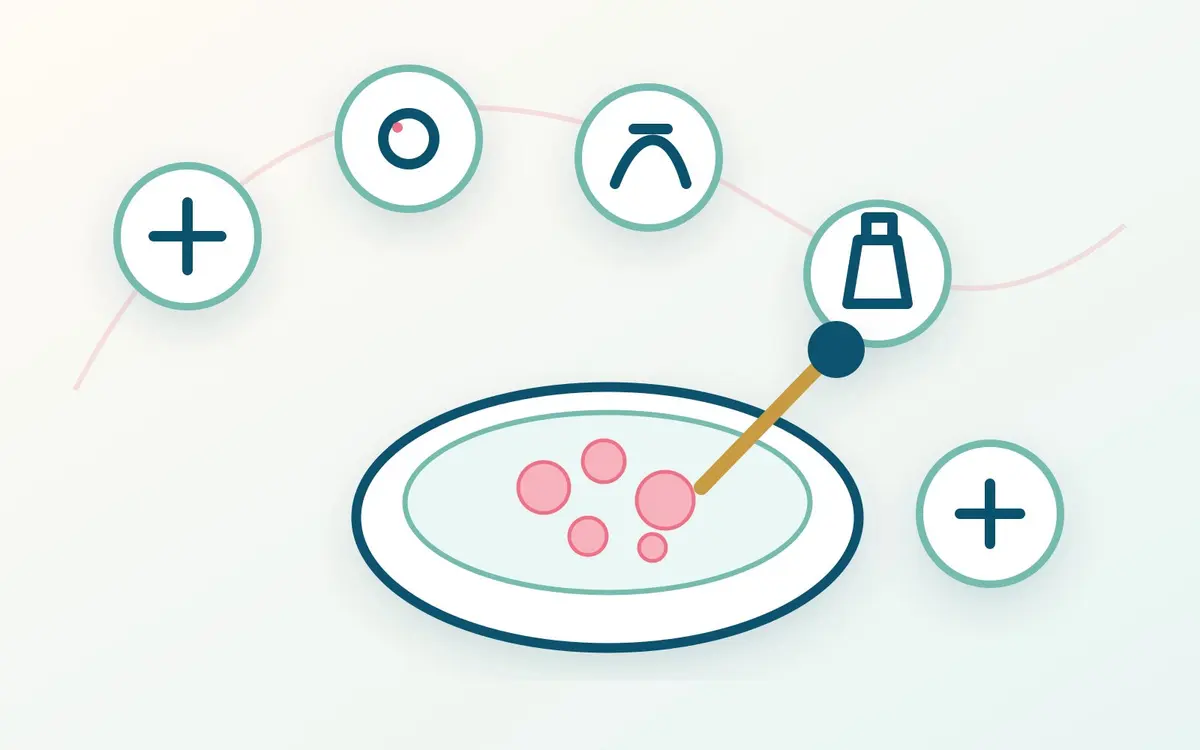
IVF brings clinical care and embryology together across a series of planned stages. In simple terms, the ovaries are stimulated so that eggs can be collected, eggs and sperm are brought together in the laboratory, suitable embryos are observed as they develop, and an embryo may be transferred to the uterus. The exact protocol and timing are individual.
Knowing the sequence can make appointments feel less unfamiliar. This guide describes a common pathway, but your specialist may recommend a different approach after reviewing both partners and your health.
Step 1: fertility assessment and a shared plan
Treatment should begin with an assessment, not with an injection schedule. The consultation usually covers menstrual and pregnancy history, previous tests or treatment, medicines, surgery and relevant medical conditions. A semen analysis and male-health review are important where applicable because fertility is a couple-level matter.
Tests are chosen to answer clinical questions. They may include an ultrasound of the ovaries and uterus, ovarian reserve markers such as AMH, semen testing and selected hormone or infection screening. A normal AMH result does not prove that conception will occur, and a single semen result may sometimes need interpretation or repetition.
The specialist should explain why IVF is being considered, reasonable alternatives, foreseeable risks, likely costs and what might cause the plan to change. Use the fertility testing guide to prepare for this discussion.
Step 2: ovarian stimulation
In a natural menstrual cycle, one follicle commonly becomes dominant. During IVF, prescribed medicines encourage a group of follicles to grow so that more than one egg may be available for collection. The dose and protocol depend on factors such as age, ovarian reserve, previous response and clinical history.
Injections are taken according to a schedule. The care team should demonstrate storage, preparation and administration and tell you what to do if a dose is delayed or missed. Do not alter a dose based on symptoms or another person’s protocol.
Some bloating, pelvic heaviness or injection-site discomfort may occur. The clinic should provide clear instructions for urgent symptoms. Ovarian hyperstimulation syndrome is an uncommon but important complication associated with an excessive response, and monitoring helps the team recognise risk and adapt the plan.
Step 3: monitoring the response
Ultrasound scans measure growing follicles, while blood tests may be used when clinically relevant. The results help the specialist adjust medicines and choose when to give the final maturation or “trigger” injection. The number of follicles is not identical to the number of eggs collected, and not every collected egg will be mature.
Appointment frequency can increase as collection approaches. People travelling within Delhi NCR can ask how much notice is usually given, while understanding that the biological response can change the date.
Step 4: the trigger and egg collection
The trigger medicine is timed carefully before egg collection. Follow the written time exactly and contact the clinic if there is any uncertainty. Egg collection is commonly performed through the vagina using ultrasound guidance, with sedation or anaesthesia as planned by the clinical team.
Before the procedure, you should receive fasting and medication instructions. Afterwards, the team will monitor recovery and explain activity, discomfort relief and warning signs. Arrange transport and do not drive if the anaesthesia team advises against it. The number of eggs collected can differ from the follicle count seen on scans.
Step 5: sperm preparation and fertilisation
A semen sample is usually planned around egg collection unless another arrangement has been made. The laboratory prepares the sample. In conventional IVF, eggs and prepared sperm are placed together. In ICSI, an embryologist injects a selected sperm into a mature egg. ICSI may be considered for selected sperm or fertilisation concerns; it is not a universal requirement.
The clinic should explain which approach is proposed and why. Our ICSI guide describes its role and limitations. Neither method can ensure that every mature egg fertilises.
Step 6: embryo culture and laboratory updates
Fertilised eggs are observed during embryo development in controlled laboratory conditions. Some embryos stop developing, and embryos from the same cycle can develop differently. The embryology team assesses development using defined observations, but appearance cannot reveal everything about an embryo’s potential.
Ask when updates are normally provided, which terms the laboratory uses and who can answer questions. Constant updates may not be possible or useful, but a clear communication schedule can reduce uncertainty. If a laboratory test or extended culture is proposed, understand the indication, limitations, additional cost and whether it changes the transfer plan.
Step 7: fresh transfer, freezing or a changed plan
An embryo transfer may occur in the same cycle, or suitable embryos may be frozen for a later transfer. The decision depends on the individual response, uterine preparation, embryo development, medical safety and the agreed plan.
During transfer, an embryo is placed into the uterus through a thin catheter. Anaesthesia is not usually required, although clinic practice and individual needs differ. The number of embryos considered for transfer should be discussed carefully because multiple pregnancy carries additional health risks. Consent must reflect the actual plan.
If embryos are frozen, ask about the storage agreement, communication responsibilities, future charges and instructions for changing or withdrawing consent. Read more in our embryo freezing guide.
Step 8: medicines, the waiting period and pregnancy testing
Medicines may be prescribed to support the uterine lining. Continue them exactly as directed and do not stop because of spotting or home-test results without contacting the clinic. The clinic will set the correct date for a pregnancy blood test or other follow-up.
Testing too early can be misleading. Symptoms during this period may be caused by medicines and do not reliably show whether implantation has occurred. Try to plan manageable routines and identify one person or service you can contact if the uncertainty feels overwhelming.
If the result is positive, follow-up will be arranged to assess early pregnancy. If it is not, you deserve a respectful review. The team can explain what was observed, what remains uncertain and whether another attempt, a modified plan or time away from treatment is reasonable. One cycle does not provide a complete verdict on a person or couple.
What IVF cannot tell or promise
IVF creates opportunities to observe fertilisation and embryo development, but it cannot remove biological uncertainty. Results vary with age, egg and sperm factors, diagnosis, embryo development, uterine health and other circumstances. A clinic-level number cannot predict an individual outcome. See how to understand IVF success information without reducing it to a promise.
The full process also includes informed consent, confidentiality and transparent financial communication. India’s Assisted Reproductive Technology (Regulation) Act, 2021 provides the national regulatory framework for ART practice.
For a detailed overview of stages, questions and risks, visit IVF treatment at Umeed IVF. To ask about arranging an assessment in Delhi, contact the care team. Personal advice must come from a registered specialist who has reviewed your history and results.
Sources and further reading
- In vitro fertilisation — Human Fertilisation and Embryology Authority
- Assisted Reproductive Technology (Regulation) Act, 2021 — India Code