
ICSI treatment · Delhi
ICSI treatment for selected fertilisation concerns
Intracytoplasmic sperm injection is a laboratory fertilisation technique used within an IVF cycle. A single selected sperm is injected into a mature egg when there is a clinical reason to consider it.
- Individual assessment
- Clear explanations
- Confidential support
Understanding ICSI
How ICSI differs from conventional IVF
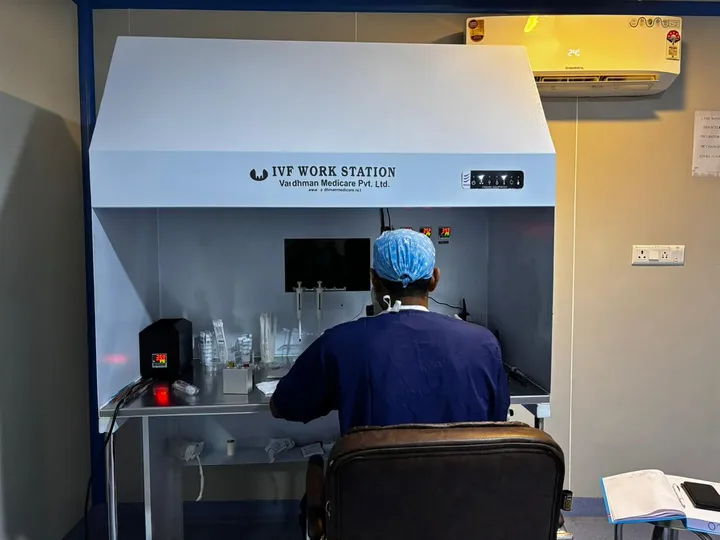
During conventional IVF, prepared sperm and eggs are placed together and fertilisation occurs without injecting a sperm into the egg. In ICSI, an embryologist selects one sperm and introduces it directly into a mature egg using specialised micromanipulation equipment. The steps before egg retrieval and after fertilisation generally remain part of the wider IVF cycle.
ICSI may help overcome some barriers between sperm and egg, but it does not correct egg quality, guarantee fertilisation or ensure that an embryo will develop and implant. Mature eggs are required, and each stage remains biologically uncertain.
The decision should follow semen analysis, clinical history and review of any previous fertilisation outcome. A responsible discussion explains why ICSI is proposed, whether conventional IVF is a reasonable alternative and whether additional male evaluation is needed.
When it may be discussed
When a specialist may discuss ICSI
ICSI is commonly associated with male-factor infertility, but selection depends on the complete clinical and laboratory context.
- 01
A low sperm count, reduced movement or significant morphology concern confirmed through appropriate semen evaluation.
- 02
Sperm obtained through a surgical retrieval procedure when ejaculation does not provide usable sperm.
- 03
Previous absent or unexpectedly low fertilisation with conventional IVF, after reviewing possible egg and sperm factors.
- 04
Use of frozen sperm or eggs where the treating and embryology teams identify a laboratory indication.
- 05
Certain medically indicated embryo-testing cycles where laboratory planning supports ICSI after counselling.
A step-by-step view
Where ICSI fits within IVF
ICSI changes the fertilisation step. Ovarian stimulation, egg retrieval, embryo culture and transfer still require an IVF plan.
- 01
Joint assessment
Both partners’ history and available reports are reviewed, with semen testing repeated or expanded when clinically appropriate.
- 02
Egg collection
After stimulation and monitoring, eggs are retrieved and assessed in the laboratory for maturity.
- 03
Sperm preparation
The semen sample or surgically retrieved material is processed so an embryologist can identify sperm suitable for injection.
- 04
Microinjection
One selected sperm is introduced into each suitable mature egg using micromanipulation equipment.
- 05
Fertilisation check
The laboratory checks for signs of fertilisation at the appropriate time and continues observing embryo development.
- 06
Transfer or freezing
A suitable embryo may be transferred when appropriate, and additional suitable embryos may be frozen with consent.
Questions worth asking
Questions to ask about ICSI
- What specific finding makes ICSI reasonable in this cycle?
- Has the semen result been interpreted with medical history and examination?
- Would further male-infertility assessment or genetic counselling be appropriate?
- How many retrieved eggs may be mature and suitable for injection?
- What are the limitations, costs and alternatives to ICSI?
- How will fertilisation and embryo-development updates be communicated?
Realistic expectations
ICSI supports fertilisation; it does not ensure pregnancy
Directly injecting a sperm can bypass certain sperm–egg interaction problems, yet an injected egg may not fertilise or continue developing. Subsequent embryo quality and implantation depend on many egg, sperm, genetic and uterine factors.
ICSI is not automatically more effective for every IVF cycle. Its value is clearest when linked to a recognised indication. Ask for an individual explanation rather than assuming that a more technical procedure always gives a better outcome.
If a significant sperm concern is present, evaluation may identify treatable health issues or reasons to discuss genetic testing. The fertility plan should consider the male partner’s health as well as the laboratory strategy.
Continue reading: Male infertility evaluation →Common questions
ICSI FAQs
General answers can help you prepare, but individual advice requires a medical consultation.
Is ICSI a complete treatment separate from IVF?
ICSI is normally the fertilisation method used inside an IVF cycle. The person providing eggs still goes through assessment, stimulation, monitoring and egg retrieval before ICSI can be performed.
Does one sperm injection always fertilise the egg?
No. Only mature suitable eggs can be injected, and fertilisation is not certain. Embryo development, implantation and pregnancy remain separate stages with their own uncertainties.
Is ICSI used for every male-factor diagnosis?
No. Semen findings vary in type and severity. A specialist may recommend repeat testing, medical evaluation, treatment of an underlying issue, IUI, conventional IVF, ICSI or another approach depending on the full picture.
Can ICSI select a baby’s traits?
No. ICSI is a fertilisation technique. It is not a method for choosing non-medical traits and it does not remove the need to follow all applicable Indian laws and ethical standards.
A calm first step
Discuss what may be appropriate for you.
Share only the details needed for a callback. The first fertility counsellor conversation is free and is not a medical diagnosis.
Private & secure enquiry
Ask about ICSI
Our care team can help you request a confidential fertility counsellor call in Delhi.
Thank you — your request has been received.
Our counsellor team will contact you. If you prefer, you can continue privately on WhatsApp now.
Continue on WhatsApp