
PGT-A information · Delhi
PGT-A genetic screening for appropriate medical indications
Preimplantation genetic testing for aneuploidy screens sampled embryo cells for certain chromosome-number abnormalities. It may support embryo-selection decisions in selected IVF cases but cannot guarantee implantation or a healthy birth.
- Individual assessment
- Clear explanations
- Confidential support
Understanding PGT-A
What PGT-A examines and where its limits begin
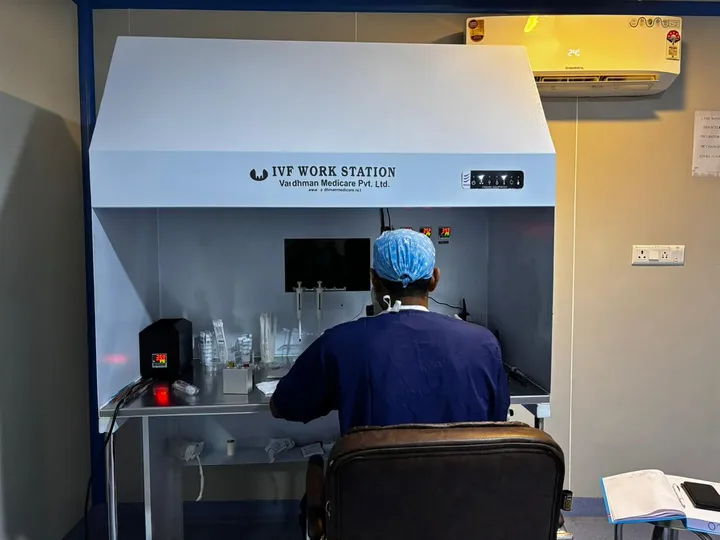
PGT-A is performed as part of an IVF cycle. Embryos usually develop to the blastocyst stage before a small sample of cells is removed from the outer layer that may later contribute to the placenta. The embryo is vitrified while an authorised genetics laboratory examines the sample for selected chromosome-number abnormalities.
The result may describe an embryo as euploid, aneuploid, mosaic or inconclusive according to the laboratory method and reporting policy. Because only a small cell sample is tested, the result is a screening assessment rather than a complete diagnosis of every cell or every genetic condition.
PGT-A does not test for all inherited disorders, birth differences or pregnancy complications. PGT for a known single-gene condition or structural chromosome rearrangement is a different pathway requiring genetic counselling and case-specific planning. Prenatal screening or diagnostic discussions may still be appropriate after pregnancy.
When it may be discussed
When PGT-A may be discussed medically
Evidence, benefits and trade-offs vary by patient group. The decision should follow reproductive and genetic counselling rather than routine marketing.
- 01
Increasing age of the egg provider, when the higher likelihood of embryo chromosome abnormalities is relevant to IVF planning.
- 02
Repeated pregnancy loss where evaluation suggests a possible chromosome-related contribution and testing is clinically appropriate.
- 03
Repeated unsuccessful embryo transfer after other embryo and uterine factors have been reviewed.
- 04
A prior pregnancy or family chromosome finding that leads the genetics team to discuss an appropriate preimplantation-testing pathway.
- 05
Cases where reducing transfer of embryos identified with particular chromosome-number abnormalities may have a clear medical rationale.
A step-by-step view
How PGT-A fits into an IVF cycle
Testing adds laboratory, genetic-counselling, consent, freezing and result-review stages to IVF.
- 01
Clinical and genetic review
The team clarifies the indication, family history, alternatives, possible results and what decisions each result may create.
- 02
IVF and fertilisation
Eggs are collected and fertilised under an individual IVF plan; not every egg fertilises or forms a blastocyst.
- 03
Embryo culture
Embryos are observed as they develop. Only embryos reaching a suitable stage can be considered for biopsy.
- 04
Biopsy and vitrification
A small sample of outer cells is taken by trained personnel, and the embryo is frozen while testing occurs.
- 05
Laboratory screening
The genetics laboratory analyses the sample using the selected validated method and issues a report.
- 06
Result counselling
Results, limitations, embryo suitability and possible frozen transfer are discussed before a decision is made.
Questions worth asking
Questions for PGT-A counselling
- What is the specific medical indication in this IVF cycle?
- What evidence suggests testing may or may not help in this age and treatment history?
- How are euploid, aneuploid, mosaic and inconclusive results defined by the laboratory?
- Could an embryo be damaged or become unavailable because of biopsy, freezing or warming?
- What happens if there are no blastocysts to biopsy or no embryo suitable for transfer?
- What prenatal screening or diagnostic discussion is still recommended if pregnancy occurs?
Realistic expectations
Screening may refine a decision; it does not remove uncertainty
PGT-A may help prioritise among embryos by identifying some chromosome-number abnormalities. Current professional guidance does not support routine PGT-A for every IVF patient or show that it improves the overall chance of a baby for everyone. It does not create healthy embryos, improve egg quality or ensure implantation.
Biopsy examines a limited sample, and mosaic or inconclusive findings can create complex decisions. Genetic counselling should explain possible false-positive, false-negative and sampling limitations using the laboratory’s reporting approach.
All testing and communication must comply with the PCPNDT Act and other applicable Indian law. Umeed IVF provides information only for legitimate medical screening of chromosomal abnormalities or inherited-disorder pathways; non-medical trait choice is not offered or supported.
Continue reading: Detailed PGT-A guide →Common questions
PGT-A FAQs
General answers can help you prepare, but individual advice requires a medical consultation.
Does PGT-A require an IVF cycle?
Yes. Embryos must first be created through IVF or ICSI, develop to a stage suitable for biopsy, and usually be vitrified while the cell sample is analysed. Not every cycle produces an embryo that can be tested.
Is PGT-A the same as PGT-M or PGT-SR?
No. PGT-A screens selected chromosome-number abnormalities. PGT-M is planned for a specific single-gene condition, while PGT-SR relates to particular structural chromosome rearrangements. Those pathways require case-specific genetic counselling.
Does PGT-A improve the chance of a baby for everyone?
No. Current professional guidance does not recommend routine PGT-A for every IVF patient. Possible value depends on the individual indication, embryos available, age, history, limitations and which decision the result would change.
Does PGT-A guarantee implantation?
No. A screened embryo may still not implant or may result in miscarriage. Uterine, embryo, medical and biological factors remain, and screening cannot identify every possible issue.
Does PGT-A test every genetic condition?
No. PGT-A focuses on selected chromosome-number abnormalities. Testing for a known inherited single-gene condition is a different pathway, and neither approach excludes every genetic or developmental condition.
Is PGT-A useful for every IVF patient?
No. Potential benefit depends on age, embryo number, reproductive history, indication, cost and the decisions a result would change. Individual counselling should cover the option of IVF without testing.
Is prenatal testing still relevant after PGT-A?
Yes. PGT-A is a screening test on sampled embryo cells. If pregnancy occurs, an obstetric and genetics team may still discuss appropriate prenatal screening or diagnostic options.
A calm first step
Discuss what may be appropriate for you.
Share only the details needed for a callback. The first fertility counsellor conversation is free and is not a medical diagnosis.
Private & secure enquiry
Ask about PGT-A
Our care team can help you request a confidential fertility counsellor call in Delhi.
Thank you — your request has been received.
Our counsellor team will contact you. If you prefer, you can continue privately on WhatsApp now.
Continue on WhatsApp